
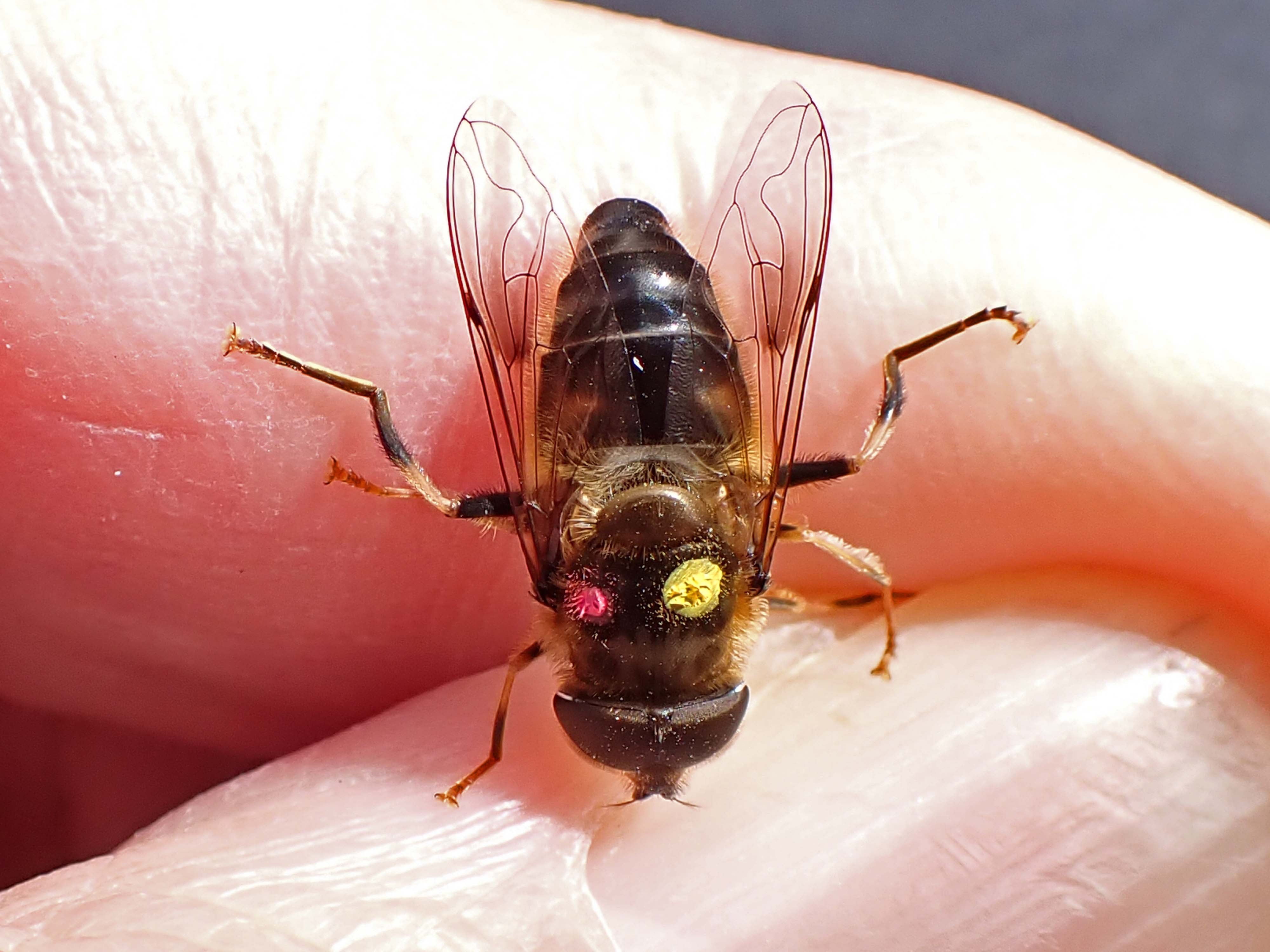
A new paper published in the British Journal of Entomology and Natural History describes a practical and inexpensive method for individually marking hoverflies, supported by Maploom’s web-based mapping and data management platform.
The research, undertaken by Andy Murdock (Maploom), Colin Easton and Paul Stevens as part of the Green Forest Hoverfly Hunt, builds on established insect marking techniques, using small, coloured paint dots to distinguish individual insects. The approach allows marked hoverflies to be recognised subsequently in the field or from photographs, potentially avoiding the need for recapture.
The method was developed and tested to support research into the rare Green Forest Hoverfly (Caliprobola speciosa) in the New Forest, helping researchers investigate individual movements, territorial behaviour, longevity and habitat use.
Maploom supported the research by providing an online gallery of individually marked hoverflies, enabling volunteers to identify individuals and record subsequent sightings. The platform also supported the mapping and analysis of observations, helping researchers investigate movements and patterns of habitat use.
The work illustrates how established ecological field techniques can be complemented by digital recording and geospatial technology to support collaborative research and conservation monitoring.
Although developed for hoverflies, the method has potential applications across a wider range of insects and ecological monitoring projects.
Publication
Murdock, A., Easton, C. & Stevens, P. (2026). A simple paint-pen method for individual marking and visual re-identification of hoverflies and other Diptera. British Journal of Entomology and Natural History, 39(3), 161–170.